Group tests into test plans
A test plan groups related test cases so you can run them together, by hand or on a schedule. You pick the test cases once, and Testmode runs every enabled one that has steps or an Expected Outcome each time the plan runs.
At Pellbrook Digital, the Toolshop Storefront project has a Storefront smoke plan for search, catalog and cart checks, and a Checkout regression plan for the signed-in cart and checkout flows.
Before you start: you need the Editor role or above to create or change plans. Everyone in the organization can see them.
Viewers see the plans without edit controls. The Test Plans list has no New Test Plan button, no Edit, Duplicate or Delete in the row menu, and a disabled Enabled switch. A plan’s page has no Add Test Case button, no controls on its test cases and no Settings or Delete menu.
Create a test plan
Section titled “Create a test plan”-
In the sidebar, click Test Plans.
-
Click New Test Plan, or press C on the Test Plans page.
-
Enter a name, for example
Checkout regression. -
Optionally add a Description, such as
Cart and checkout flows for a signed-in customer. -
Under Test Cases, tick the test cases the plan should run. Search by name or tag to narrow the list. Only enabled test cases appear here.
-
Leave Enabled on, then click Create Test Plan.
The plan appears in the Test Plans list with its Test Cases count and Last Run. You can also create an empty plan and add test cases later.
To rename a plan or change its description, choose Edit in the plan’s row menu, or Settings in the menu on the plan’s page, then click Save Changes.
Add and remove test cases
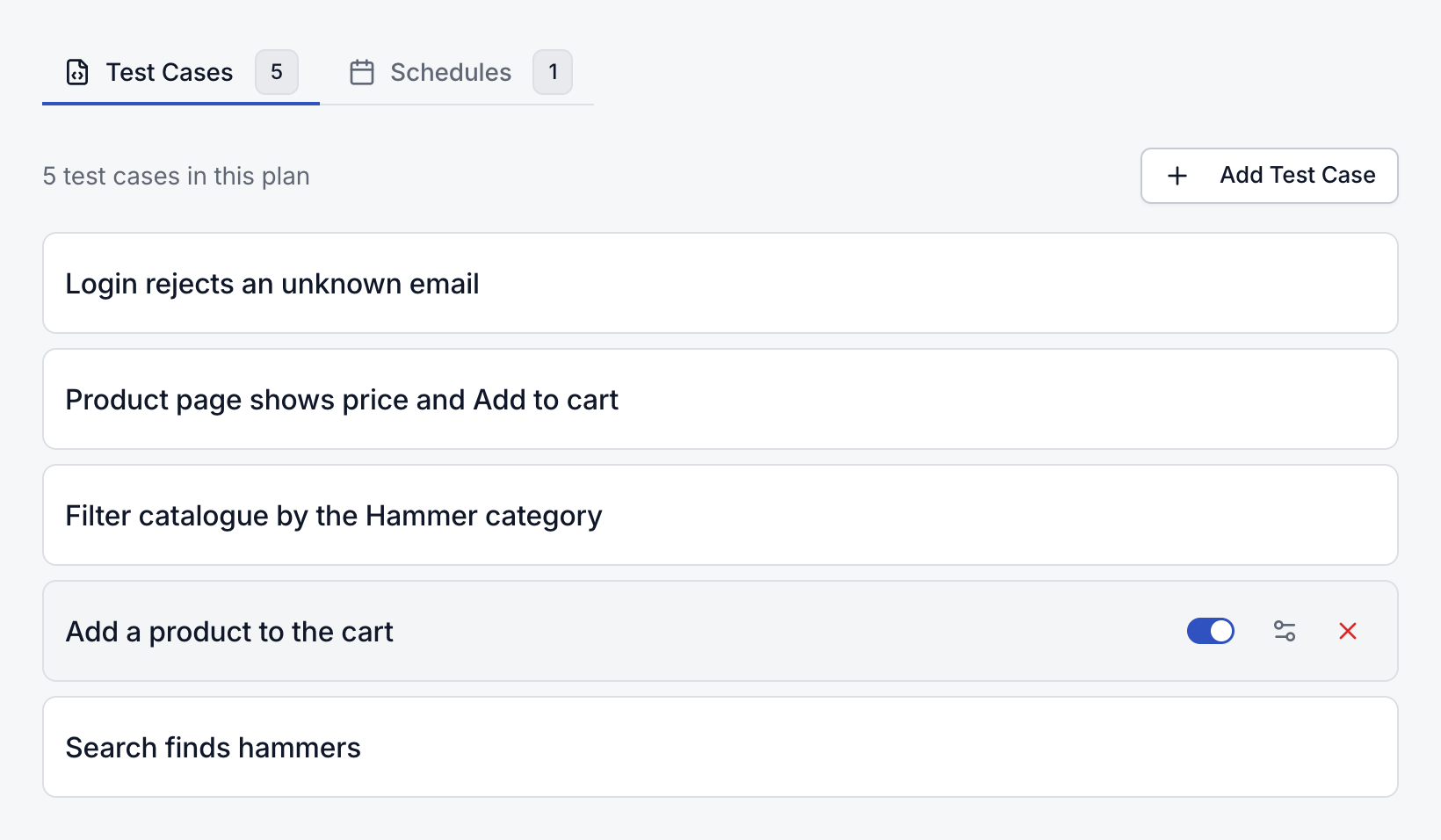
Section titled “Add and remove test cases”Open a plan to see its Test Cases tab.
-
Click Add Test Case.
-
In the Add Test Cases dialog, tick one or more test cases. The list shows enabled test cases that are not in the plan yet.
-
Click Add (n), where n is the number you ticked.
To remove a test case, hover its row and click the X. It is removed straight away, with no confirmation. The test case itself is kept, and so is its place in any other plan.
If Testmode refuses a change to a plan, it shows an error such as “You don’t have permission to change this test plan” instead of a confirmation.
You can also manage plan membership from the test case side, and create a new plan in the same step. See Organize test cases.
Override the login for one test case
Section titled “Override the login for one test case”A test case with a Login Credential normally logs in with that credential. In a plan, you can make it log in with a different credential, only when it runs as part of this plan.
-
On the plan’s Test Cases tab, hover the test case and click the settings icon (two sliders), between the Required switch and the X.
-
In Configure Test Case, open Credential Override.
-
Choose a credential. Use default keeps the test case’s own credential, shown in brackets.
-
Click Save.
The row now shows an Override badge, and its “Login:” line names the credential the test will use.
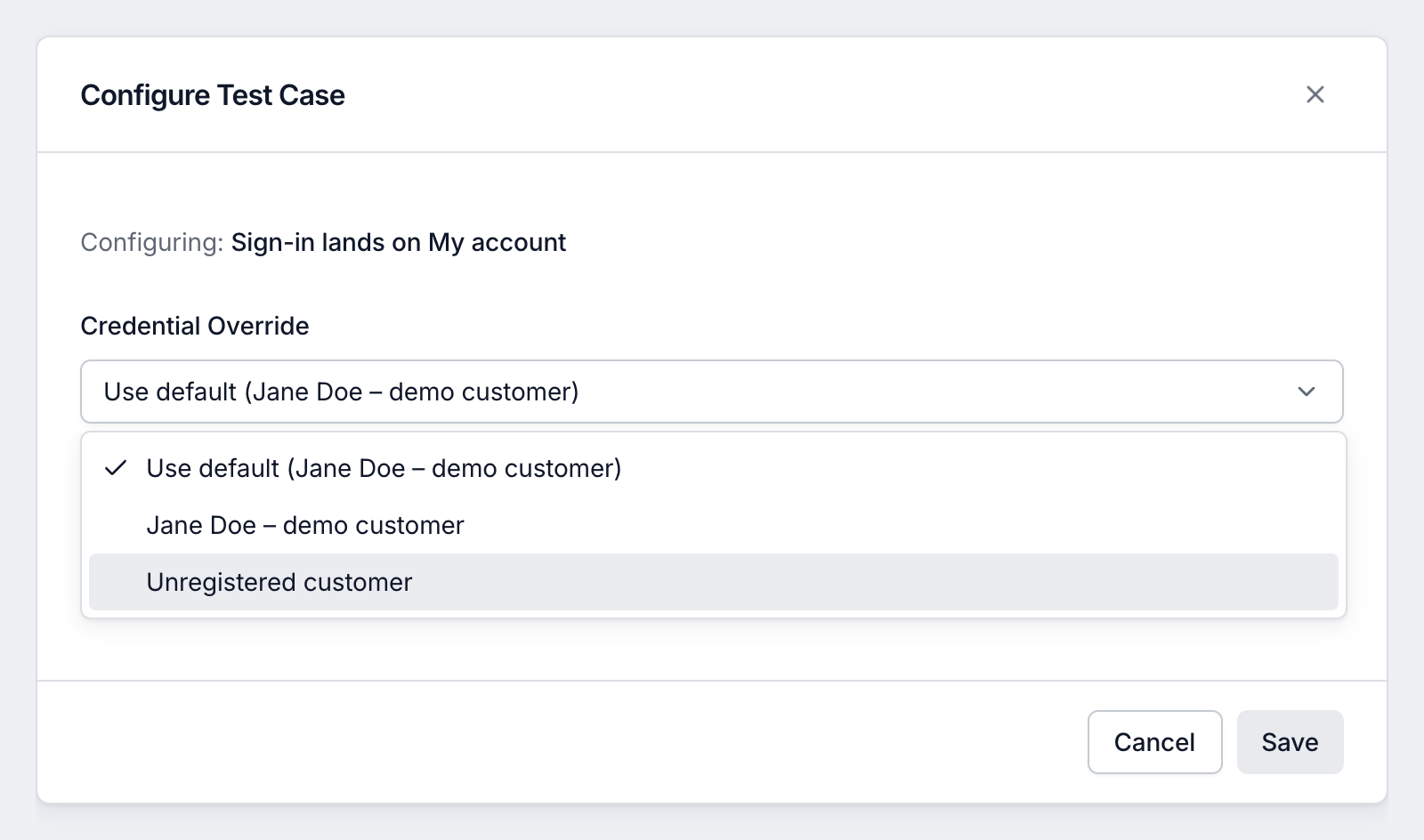
The override applies whenever the plan runs, including scheduled runs. Running the same test case with Single test or All test cases uses the test case’s own credential. If the override credential is deleted later, the override is cleared and the test case’s own credential is used again. See Credentials and automatic login.
The Required switch
Section titled “The Required switch”Each test case in a plan has a Required switch, on the row when you hover it and in Configure Test Case. Turning it off shows an Optional badge.
Enable or disable a plan
Section titled “Enable or disable a plan”Use the Enabled switch in the Test Plans list, or in the plan’s edit dialog. A disabled plan is dimmed in the list, shows a “Disabled” badge on its page, and is hidden from the plan list in the Run tests dialog.
Duplicate or delete a plan
Section titled “Duplicate or delete a plan”Both actions are in the plan’s row menu in the Test Plans list.
- Duplicate creates a copy with “ (copy)” added to the name. It copies the description, the enabled state, and every test case with its credential override and Required setting. It does not copy schedules or run history.
- Delete asks you to confirm, then permanently deletes the plan. You can also delete from the menu on the plan’s page.
Related
Section titled “Related” testmode
Better software quality. No manual testing. Your team knows the software. Testmode does the testing.