Schedule test plans
A schedule runs a test plan automatically, at a time you choose, against one environment. Testmode starts the run for you and can email a report when it finishes.
Schedules belong to a plan. A plan can have several, for example one per environment.
Before you start: you need a test plan with at least one enabled test case that has steps or an Expected Outcome, and the Editor role or above. For advice on how often to run which tests, see regression testing without a QA team.
Viewers can open a plan’s Schedules tab and see its schedules, but not change them. The tab reads “Schedules run this test plan automatically. You need the Editor role or above to change them.” There is no Add Schedule button, no edit or delete icons, and each schedule’s switch is disabled.
Add a schedule
Section titled “Add a schedule”-
Open the plan from Test Plans and select the Schedules tab.
-
Click Add Schedule. The New Schedule dialog opens with the plan’s name under Test Plan.
-
Choose the Environment the plan should run against, for example
Production. -
Set Frequency, Time and Timezone. The preview shows a description such as “Weekly on Monday, Wednesday, Friday at 06:00” and the next run in your local time.
-
Choose when to send Email reports and add Recipients. See Email run reports.
-
Leave Enabled on and click Save.
The schedule appears on the Schedules tab with its environment, recipients and next run time.
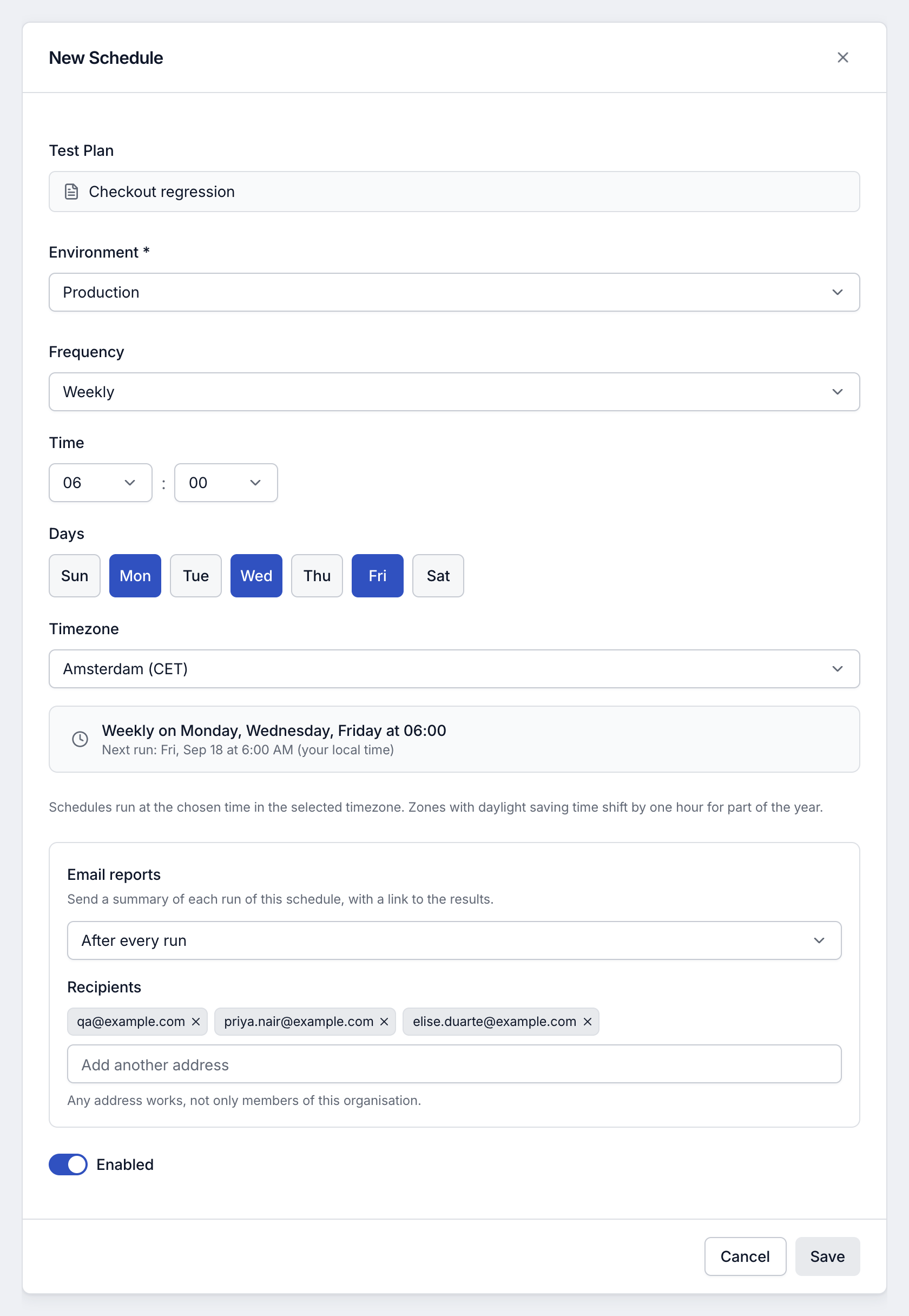
A new schedule starts as Daily at 09:00 in your browser’s timezone, with reports set to Only when a test fails and sent to your own email address. It preselects the project’s oldest environment, which is not always the project’s default, so check Environment before you save.
Choose frequency and time
Section titled “Choose frequency and time”| Frequency | Settings | Example |
|---|---|---|
| Hourly | Run every 1, 2, 3, 4, 6, 8 or 12 hours. No time picker. | Every 6 hours |
| Daily | Time | Daily at 07:30 |
| Weekly | Days (Sun to Sat) and Time | Monday, Wednesday and Friday at 06:00 |
| Monthly | Day of month (1 to 28) and Time | Day 1 at 09:00 |
Minutes can be :00, :15, :30 or :45. A Weekly schedule needs at least one day. If you untick them all and click Save, Testmode shows “Select at least one day of the week” and saves nothing.
Timezones and daylight saving time
Section titled “Timezones and daylight saving time”Timezone offers 13 choices: UTC, Eastern Time (US), Central Time (US), Mountain Time (US), Pacific Time (US), London (UK), Paris (CET), Berlin (CET), Amsterdam (CET), Tokyo (Japan), Shanghai (China), Singapore and Sydney (Australia).
The Next run preview, and the next run shown on the Schedules tab, are always in your browser’s local time. The schedule’s description on the tab names the timezone by its ID, for example “Daily at 07:30 (Europe/Amsterdam)”.
The dialog notes: “Schedules run at the chosen time in the selected timezone. Zones with daylight saving time shift by one hour for part of the year.”
In practice, Testmode fixes the time using the zone’s offset on the day you save. A schedule saved in winter for 09:00 Amsterdam time runs at 10:00 Amsterdam time in summer. To realign it after a clock change, open the schedule and save it again.
Hourly and monthly schedules
Section titled “Hourly and monthly schedules”- Hourly every 2 to 12 hours runs at hours counted from midnight UTC, not your local midnight. Every 6 hours means 00:00, 06:00, 12:00 and 18:00 UTC.
- Monthly schedules set close to midnight can land on the day before or after the day you chose, in your local time.
- If your browser’s timezone is not one of the 13 choices, Timezone looks blank on a new schedule but still saves your zone. Picking a choice from the list replaces it.
What happens when a schedule fires
Section titled “What happens when a schedule fires”A scheduled run is a normal plan run on the schedule’s environment:
- Every enabled test case in the plan runs, each in its own cloud browser. Disabled test cases are left out, and so are test cases with no steps and no Expected Outcome.
- Credential overrides from the plan apply.
- On the Runs page, Triggered By shows
Scheduled.
You read the results exactly as for a run you start yourself. See Read run results.
When a schedule does not run
Section titled “When a schedule does not run”| Situation | What Testmode does |
|---|---|
The schedule’s previous run is still Queued or Running |
Skips that time. No run is recorded. |
| The plan is empty, or all its test cases are disabled | Skips that time silently. No run and no email. |
| None of the plan’s enabled test cases has steps or an Expected Outcome | Records a run with status Skipped and a reason such as “None of the 2 test cases has steps or an expected outcome to check. Add at least one step.” It is not charged and sends no email. |
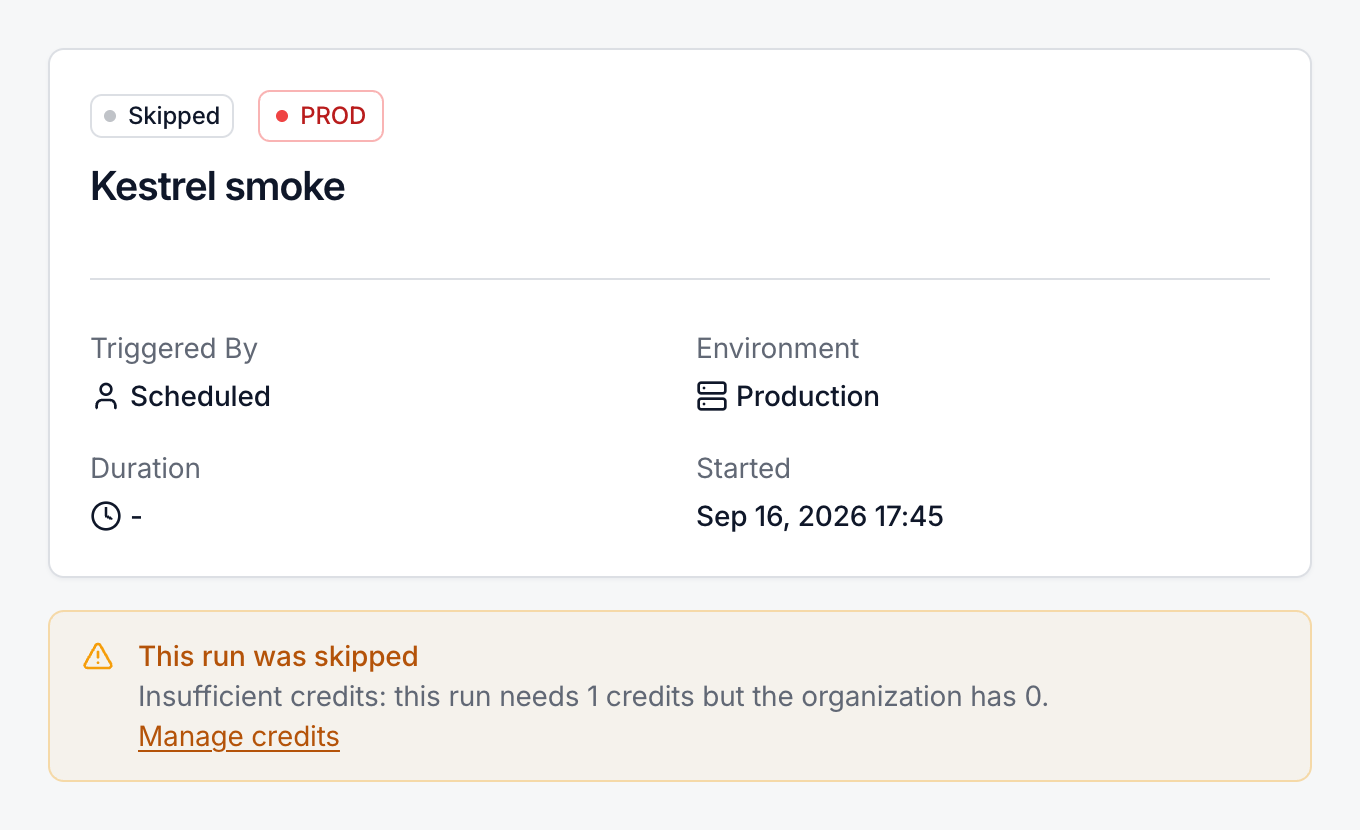
| The organization does not have enough credits | Records a run with status Skipped and the reason. It is not charged and sends no email. |
| The schedule is switched off | Never runs. |
A skipped run shows “This run was skipped”, the reason, and a Manage credits link. A skipped time is not retried; the schedule tries again at its next time.
If the reason is missing steps, buying credits does not help: add steps to the plan’s test cases. The plan’s Test Cases tab marks them No steps; see Test cases marked No steps.
See How credits work for how a run’s cost is worked out.
Turn a schedule off or delete it
Section titled “Turn a schedule off or delete it”On the plan’s Schedules tab, each schedule has:
- a switch that turns it on or off straight away. A switched-off schedule shows a “Disabled” badge and no next run.
- a pencil icon to edit it.
- a trash icon to delete it, after you confirm.
Deleting a schedule does not change the plan. Deleting the plan, or the environment the schedule uses, deletes the schedule too.
Related
Section titled “Related” testmode
Better software quality. No manual testing. Your team knows the software. Testmode does the testing.