Run tests
You start a run from the Run tests dialog: pick an environment, pick what to run, check the credit cost and click Run. Testmode runs each test in its own cloud browser and takes you straight to the run’s page, where results come in.
Before you start: you need the Editor role or above, at least one environment, and at least one enabled test case with steps or an Expected Outcome.
Open the Run tests dialog
Section titled “Open the Run tests dialog”Use whichever is closest:
- Click Run test at the top right of any page while a project is selected.
- Press CmdR on Mac or CtrlR on Windows and Linux.
- Open the command palette with CmdK or CtrlK and choose Run test.
- Choose Run in the row menu of a test case or a test plan. That test case or plan is preselected.
Clicking Run test on a plan’s page also preselects that plan, as long as it is enabled and not empty.
A test case with no steps and no Expected Outcome shows Run (add a step first) in its row menu, and the item is disabled. Add a step to run it.
Choose an environment
Section titled “Choose an environment”Under Environment, pick where the tests run. The project’s default environment is selected for you.
Production environments carry a PROD badge. The badge is a label only: Testmode does not block or warn before a run on production. Tests that place orders or send forms do that for real, so run them only against environments meant for testing. See Environments.
Choose what to run
Section titled “Choose what to run”Under What to run, pick one of three options:
| Option | What runs | Run name |
|---|---|---|
| All test cases | Every enabled test case in the project. The number next to the option counts them. | All Test Cases |
| Test plan | Every enabled test case in the plan you select | The plan name |
| Single test | The one test case you select | The test case name |
Test plan appears only when the project has at least one enabled plan. Each plan in the list shows its test count, for example Storefront smoke (5 tests). That count includes disabled test cases and test cases without steps, which are left out of the run.
Credential overrides set in a plan apply only when the plan runs, as a Test plan run or on a schedule. All test cases and Single test use each test case’s own credential. See Group tests into test plans.
Test cases without steps are skipped
Section titled “Test cases without steps are skipped”A test case with no steps and no Expected Outcome gives the agent nothing to check. Testmode leaves it out of the run and does not charge for it.
- In the Single test list, such a test case is marked “(no steps)”.
- When your choice includes any, an amber notice says so, for example “1 of 5 test cases has no steps or expected outcome and will be skipped.”
- For a single test, the notice reads “This test has no steps or expected outcome to check. Add at least one step.”
- When nothing runnable is left, Run is disabled.
Check the cost
Section titled “Check the cost”The dialog footer shows what the run will cost and what your organization has, as “Uses N credits · M available”. Each test case costs one credit per step you wrote in it, and at least one credit. Skipped test cases are not counted. Until there is something to run, the footer reads “One credit per test step”.
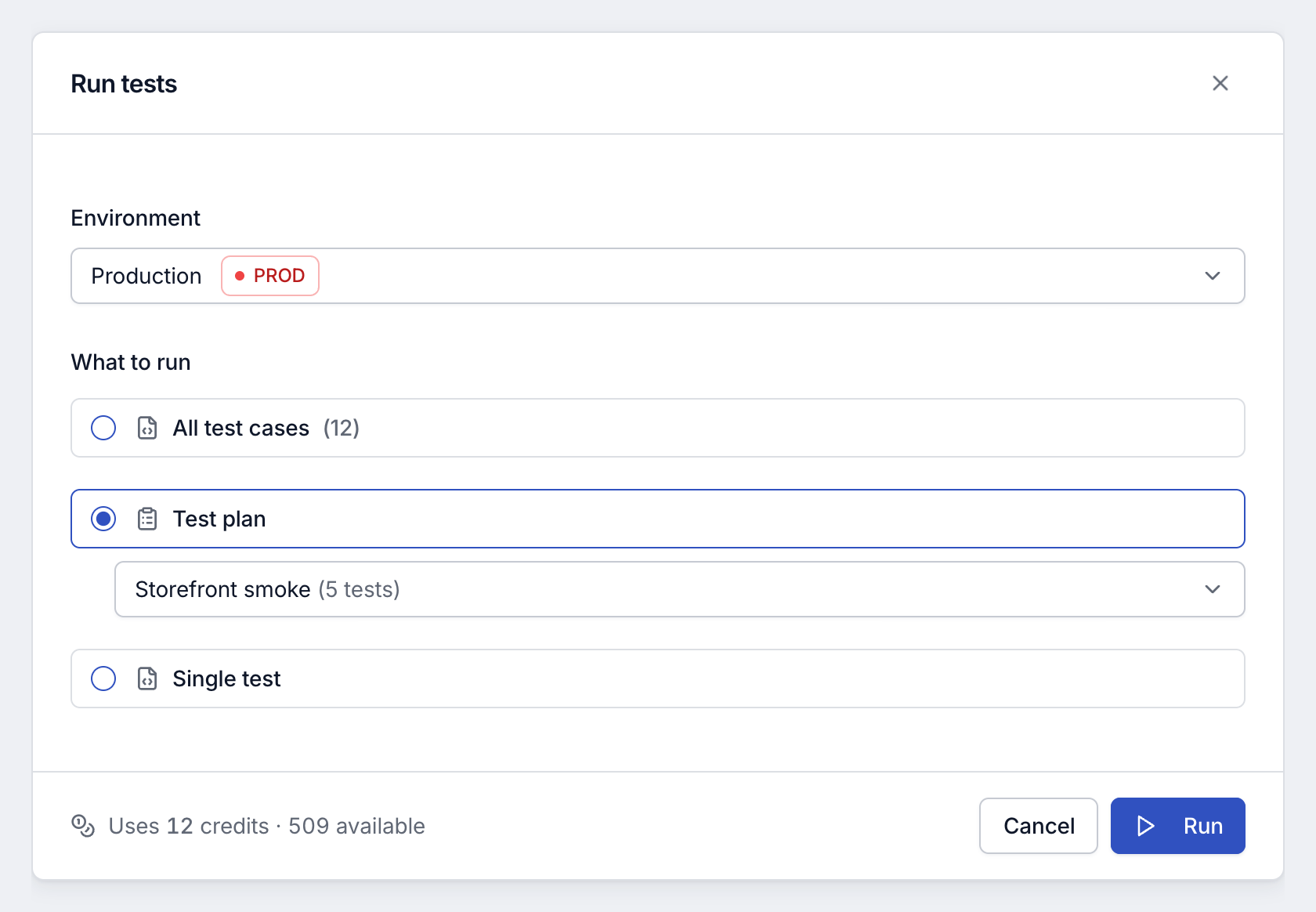
If the run costs more than the balance, the line turns amber and Run is disabled. Owners and Admins see a Buy credits link. Other roles see “ask an organization admin to buy credits”.
Click Run to start. The dialog closes and you land on the run’s page. Each test waits in Queued until a browser is free, and the run page says what it is waiting for. See Read run results.
Testmode checks the cost and the test cases again when you click Run. If something changed since you opened the dialog, you see “Not enough credits” or “Failed to start test run” with the reason. See How credits work for when credits come back.
Re-run a previous run
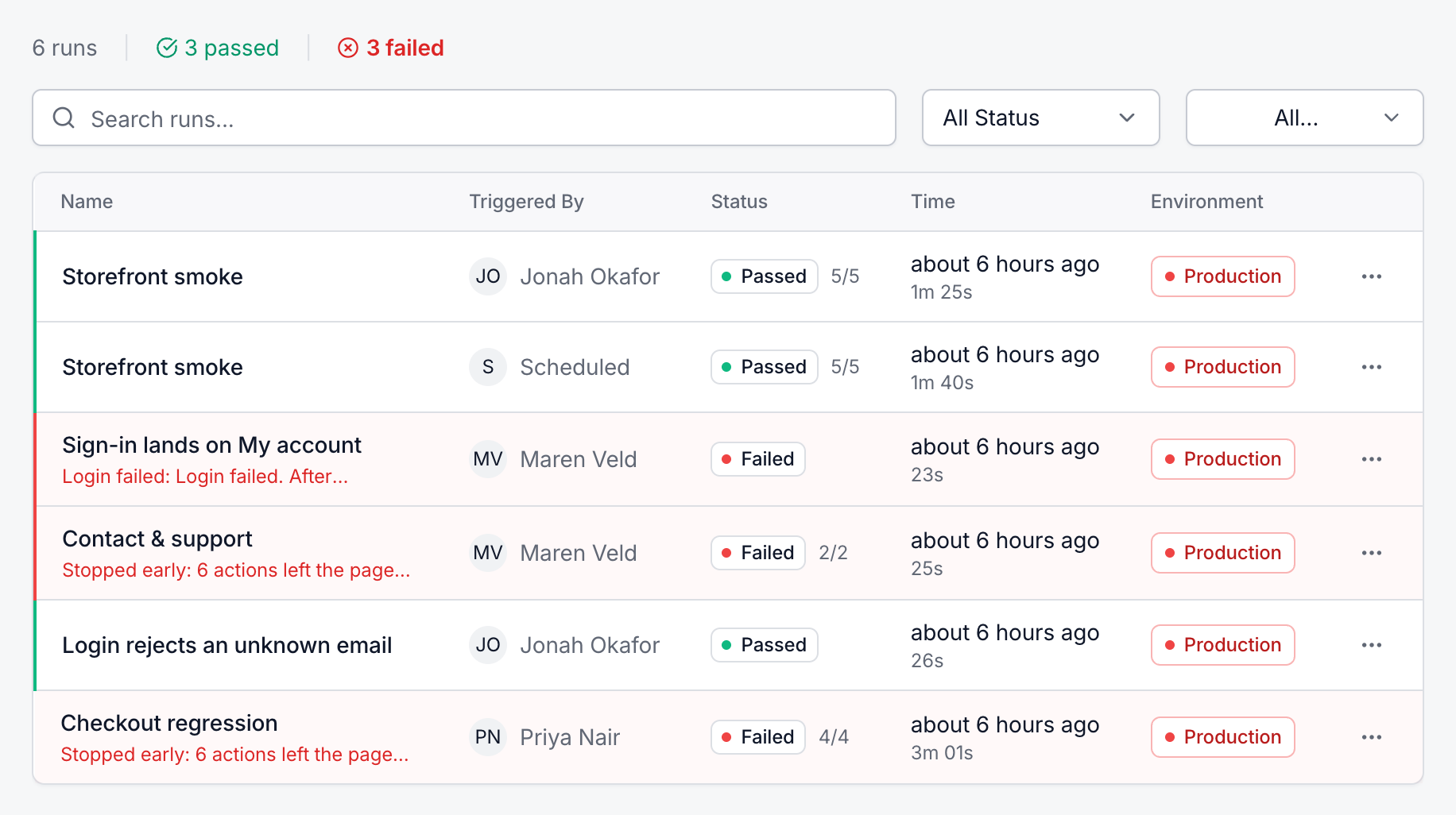
Section titled “Re-run a previous run”On the Runs page, or in Recent runs on Overview, open a run’s row menu and choose Re-run.
- For a plan run, Testmode runs the plan as it is now, on the same environment. Test cases added to or removed from the plan since then are reflected.
- For any other run, it runs the same test cases on the same environment. Test cases disabled since then, or left without steps, are left out.
Re-run starts straight away, with no dialog and no cost preview, and takes you to the new run. If it cannot start, you see “Failed to re-run” with the reason, for example that the organization does not have enough credits or that none of the test cases has steps.
The same menu has View details and Copy link. Copy link copies the run’s address, which only members of your organization can open.
Stop a run
Section titled “Stop a run”You cannot stop a run once it has started. Every test in it runs until it reaches a verdict. The status filter on the Runs page lists Canceled, but runs do not end in that status today.
Re-run only the failed tests
Section titled “Re-run only the failed tests”There is no way to re-run only the failed tests of a run: Re-run repeats the whole run. To retry one failed test, open the Run tests dialog and start a Single test run for that test case.
Who can start runs
Section titled “Who can start runs”Starting runs needs the Editor role or above. Everyone in the organization can open the Runs page and read results. See Roles and permissions.
For Viewers:
- The Run test button and the command palette’s Run test are hidden.
- CmdR or CtrlR reloads the page.
- Re-run still appears in the Runs row menu, but Testmode refuses it with “Failed to re-run” and “Viewers cannot start test runs”.
Related
Section titled “Related” testmode
Better software quality. No manual testing. Your team knows the software. Testmode does the testing.