Site map
Every page it visited, with a screenshot, the page type and what the page does.
An exploration sends the exploratory agent through one of your environments in a cloud browser. It maps the pages it finds, compares them with your existing test cases and proposes new and updated tests for you to review.
You choose where it starts, how many pages it may visit and whether it may interact with the site. Nothing in your project changes until you apply the proposals you accept.
The agent visits pages one by one, up to the page budget you set. On each page it takes a screenshot and records what the page is for, its main actions, its forms and any errors it shows. Then it compares what it saw with your test suite.
Site map
Every page it visited, with a screenshot, the page type and what the page does.
Proposals
New test cases, updates to existing ones, cases to disable, plans, variables and advice.
Coverage map
Each feature area of your app marked Covered, Partial or Not covered by your tests.
Summary
What the agent found, in a few sentences of plain English.
For example, Pellbrook Digital points an exploration at the Toolshop’s Production environment with the focus “Concentrate on search, catalogue filters, the cart and checkout”. The agent maps the pages it reaches from the home page, and proposes tests wherever their suite has gaps. See Review and apply proposals for what to do with the results.
Click Explore in the sidebar, or press G then E.
Click New exploration, or press C.
The New exploration dialog opens with the project’s default environment selected.
You can also open the dialog from the command palette: press CmdK on a Mac or CtrlK on Windows and Linux, then choose Start exploration. On the Assistant page, the suggestion Explore my site and suggest test cases opens it too.
While an exploration is in progress, New exploration is disabled and its tooltip reads “An exploration is already running”.
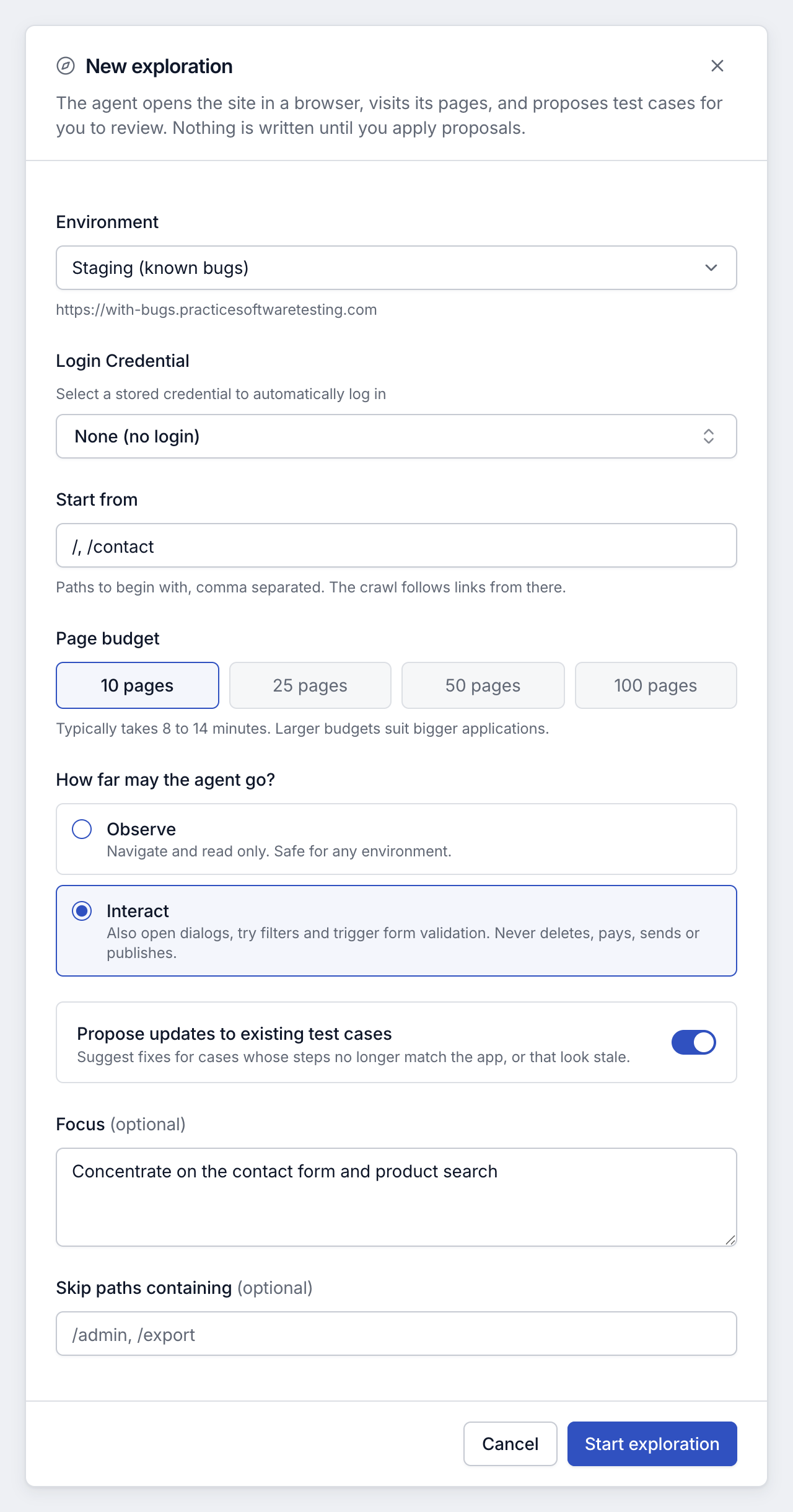
Environment is the site the agent explores. The dialog shows its Base URL underneath, and a PROD badge on production environments.
Login Credential is optional. It shows None (no login) until you pick a stored credential, then “Will log in as” and the credential’s username.
Failed with “Login failed: …”.The picker lists every credential in the project, including ones scoped to another environment, so check that the one you pick works on the environment you explore.
While an exploration runs with a credential, it counts toward that credential’s Parallel browser sessions limit, so tests that use the same login may wait until it finishes. See Credentials and automatic login.
| Field | What it does | Toolshop example |
|---|---|---|
| Start from | The paths where the agent begins, comma separated. It follows links from there. Defaults to /. |
/, /contact |
| Page budget | The most pages the agent visits: 10 pages, 25 pages (the default), 50 pages or 100 pages. | 25 pages |
| Propose updates to existing test cases | On by default. The agent also suggests fixes for test cases whose steps no longer match the app, or that look stale. Switch it off to get only new proposals. | On |
| Focus (optional) | Plain-English guidance on what matters most. It also appears under the exploration in the list. | Concentrate on search, catalogue filters, the cart and checkout |
| Skip paths containing (optional) | Paths to leave out, comma separated. | /admin, /export |
Good to know:
/admin also skips /administrators.Under How far may the agent go?, choose what the agent may do on each page.
| Mode | What the agent does | Use it for |
|---|---|---|
| Observe (default) | Navigates between pages and reads them. | Any environment, including production. |
| Interact | Everything Observe does. On a few of the most interactive pages it also tries interactions: it is instructed to open menus and dialogs, try search, filters and sorting, and submit forms empty or with invalid values to see the validation messages. Its findings appear as Observed behaviour on those pages in the site map. | Test and staging environments, when you want proposals for validation and edge cases. |
In Interact mode the agent is instructed never to delete, pay, send or publish anything, and not to sign out or leave the site. These are instructions to the agent, not technical locks.
When you pick an environment marked as production, the dialog switches to Observe, greys out Interact and shows an amber warning that production is explored read-only. Testmode applies Observe to production explorations on the server as well, so a production environment is never explored in Interact mode, whichever way the exploration was started.
In Observe mode the agent only navigates and reads, with two exceptions:
See Mark an environment as production.
Check Environment and Start from. Start exploration stays disabled until both are set, and the footer reads “Pick an environment and at least one start path”.
Click Start exploration.
Testmode shows “Exploration started” and opens the exploration’s page.
The exploration’s page updates by itself as the agent works.
The Explore list shows every exploration in the project with Exploration, Status, Pages, Proposals and Started. While an exploration runs, Pages reads visited over budget, such as 12 / 25.
| Status | Heading on the page | What is happening |
|---|---|---|
Queued |
Waiting for a browser | Waiting for a free cloud browser, or for another sign-in with the same credential to finish. The page shows “Waiting for a browser session…”. |
Exploring |
Exploring the application | Visiting pages and filling in the site map. |
Probing |
Trying interactions | Interact mode only: trying menus, filters and form validation. |
Analysing |
Analysing coverage | Comparing what it found with your test suite and writing proposals. |
Ready for review |
Ready for review | Proposals are waiting for you. |
Applied |
Applied | At least one proposal has been applied to the project. |
Failed |
Exploration failed | The exploration could not finish. The page reads “Stopped after N pages.” and a “What went wrong” box gives the reason, or “The exploration could not finish.” when there is none. |
Canceled |
Canceled | Someone stopped it. There are no proposals. |
An exploration can go back to Queued for a moment after it started, for example when no browser is free or Testmode restarts. It then starts again from the beginning, and the site map fills in again.
A failed exploration explains itself. For example:
Both need the Editor role or above.
To stop an exploration in progress, click Stop on its page, or open the row menu in the Explore list and choose Stop exploration. Testmode shows “Exploration will stop after the current page”.
Queued exploration is canceled straight away.Exploring or Probing stops before its next page and ends as Canceled. No analysis runs, so there are no proposals.Analysing finishes the analysis, then discards it and ends as Canceled.To delete a finished exploration, open its row menu, choose Delete, then click Delete in the Delete exploration? dialog. This removes the exploration, its site map and its proposals. Test cases, plans and variables you already applied from it stay in the project. Deleting cannot be undone.
Stop an exploration before you delete it. Delete appears in the row menu only once the exploration has ended, whether it is ready for review, applied, failed or canceled.
You can ask the Assistant to explore for you, for example: “Explore the Production environment and tell me which tests we’re missing.” It is instructed to confirm the environment with you first, and the credential if the app needs a login.
Starting an exploration from chat needs the Editor role or above and a credit balance above zero, as in the app. See Create tests with the Assistant.
 testmode
Better software quality. No manual testing. Your team knows the software. Testmode does the testing.